Nick Karagiannis on Melbourne Photography: Best Suburbs for Vintage Vibes
Where Nostalgia Meets Texture Through the Lens
Nick Karagiannis has spent years exploring the layered textures of Australian cities, from the sun-bleached edges of Sydney to the architectural drama of Adelaide. But when it comes to vintage atmosphere, Melbourne holds something special.
“Melbourne wears time on its sleeve,” Nick says. “It’s in the typography, the bricks, the way light seeps into narrow alleys. The past doesn’t just exist here, it speaks.”
For analogue photographers seeking depth, grain, and mood, Melbourne’s inner suburbs are a treasure map. And with a roll of Portra or HP5 loaded into a classic SLR or twin-lens reflex, the city’s layers reveal themselves one frame at a time.
Here are Nick’s top picks for capturing that elusive vintage aesthetic, each suburb shaped by history, light, and story.
Fitzroy: A Living Time Capsule with Creative Soul
For Nick, no Melbourne photography journey begins without a walk through Fitzroy. It’s where Bohemia meets brutalism, and where heritage facades collide with vibrant murals, faded signage, and wrought-iron balconies.
Why It Works: The textures are everywhere, weathered shopfronts, vintage bikes chained to rusting poles, vinyl record shops with perfectly aged windows. The light here shifts slowly through the day, often softened by leafy canopies or cloud-filtered skies.
Best Film: Kodak Portra 400 for rich colour with subtle contrast, or Ilford HP5 for a grittier, documentary feel.
Nick’s Favourite Gear: Rolleiflex 3.5 for medium format portraits, or his Olympus OM-1 from the Nick Karagiannis vintage camera collection for lightweight roaming.
Nick recommends exploring early mornings for solitude or golden hour when the cafes hum and shadows stretch across the bluestone footpaths.
“Fitzroy isn’t about taking, it’s about noticing. If you rush, you miss everything,” he says.
It’s a fantastic match for Kodak Tri-X or Cinestill 800T.
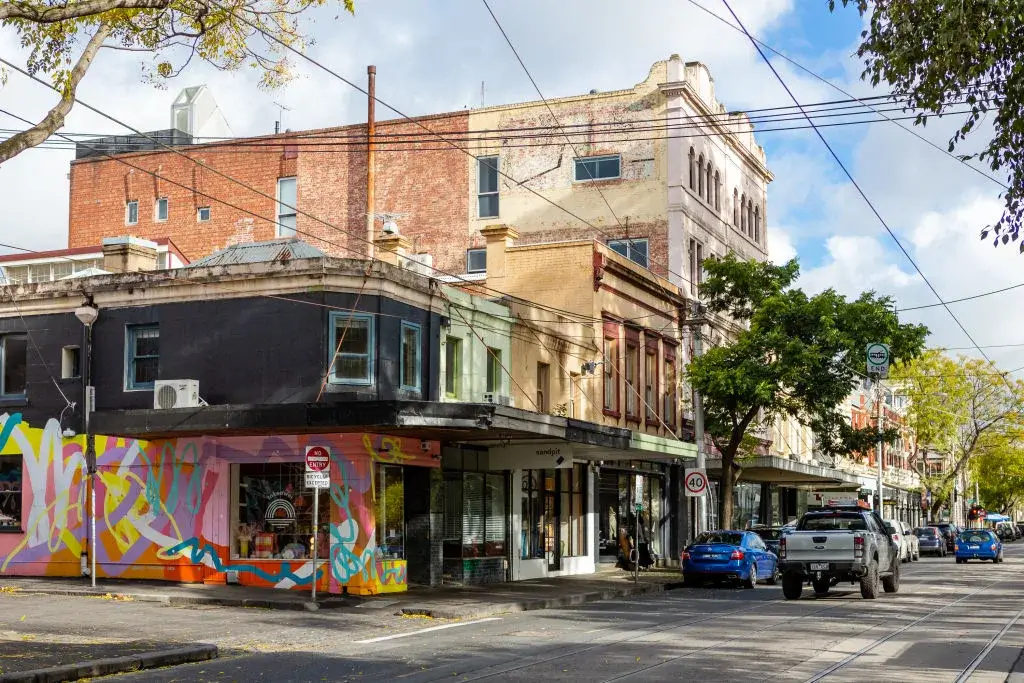
Brunswick: Honest, Unpolished, Endlessly Expressive
Brunswick offers a grittier counterpoint to Fitzroy’s curated charm. It’s where industrial warehouses back onto community gardens, where hand-painted shop signs still hang, and where decades-old homes sit unbothered beside minimalist new builds.
Nick’s Note: “Brunswick is an honesty test. You can’t fake a photo here. If you’re not emotionally present, it shows.”
He often starts on Sydney Road, catching tramlines, neon signage, and second-hand furniture shops, before wandering down into side streets and laneways that tell stories through fading posters, rust patterns, and sun-worn brickwork.
Ideal Film Stock: Portra 800 shot at 400 for added warmth in shadowy areas.
Composition Tip: Let the clutter speak. Embrace the asymmetry. Brunswick rewards imperfection.
Nick has written about Brunswick’s layered mood in the Nick Karagiannis blog, sharing frame sequences that focus on moments between movements, a nod to the suburb’s unforced character.
Bring a roll of Portra 400 or Ektar 100 to capture its subtle colour palette and rich urban textures.

Flinders Street Station and Surroundings: Classic Geometry in Motion
Few places in Australia offer as iconic a backdrop as Flinders Street Station. But Nick sees more than the facade. He focuses on the human movement across time, commuters, lovers, musicians, and tourists all flowing through lines of symmetry and history.
“There’s beauty in watching how people interrupt architecture,” he says. “You get one perfect second where everything aligns, then it’s gone.”
Time to Shoot: Blue hour or overcast mornings when tones are flat and shadows fall gently across the building’s yellow facade.
Camera Pairing: Nikon F3 with a 50mm lens to handle the shifting crowds and layered compositions.
Suggested Film: Ilford Delta 3200 for handheld shots at dusk, or Cinestill 800T for cinematic renderings under street lights.
Beyond the station itself, Nick recommends exploring the nearby laneways behind Fed Square and the tram lines near Swanston Street for wide perspectives with vintage soul.

Capturing Light and Weather in Melbourne’s Unpredictability
Shooting Melbourne with vintage film gear means embracing the unexpected. Cloud cover can shift dramatically, and light bounces unpredictably off wet pavements, glass, and concrete.
Nick recommends always carrying at least one high-speed film stock and metering with your eyes before trusting the gear.
“Melbourne isn’t forgiving, it’s revealing,” he says. “That’s why I love it. It exposes you as much as your frame.”
Collingwood: Industrial Bones, Artistic Spirit
Collingwood sits adjacent to Fitzroy but has a more industrial backbone. Its warehouses, converted galleries, and ghost signs offer an entirely different energy, quieter, rawer, and steeped in the working-class history of Melbourne.
“I shoot Collingwood when I want to feel grounded,” says Nick Karagiannis. “There’s strength in its walls. The textures are thick, and the light plays slowly.”
He gravitates toward Smith Street and its surrounds, especially in the early morning when the shops haven’t yet opened and shadows stretch across the footpath. Decay and design live side-by-side, faded brick against mural backdrops, iron fences casting sharp shadows on bluestone.
Best Film Stock: Ilford FP4 Plus for sharp black-and-white contrast. Or Kodak Gold for a slightly nostalgic warmth.
Favourite Setup: Leica M3 with a 35mm lens. Lightweight, discreet, and ideal for slow, observational frames.
Nick recommends letting the streets guide you, “You don’t map Collingwood. You wander through it.”

Melbourne Laneways (CBD): Cinematic Playground of Texture and Tone
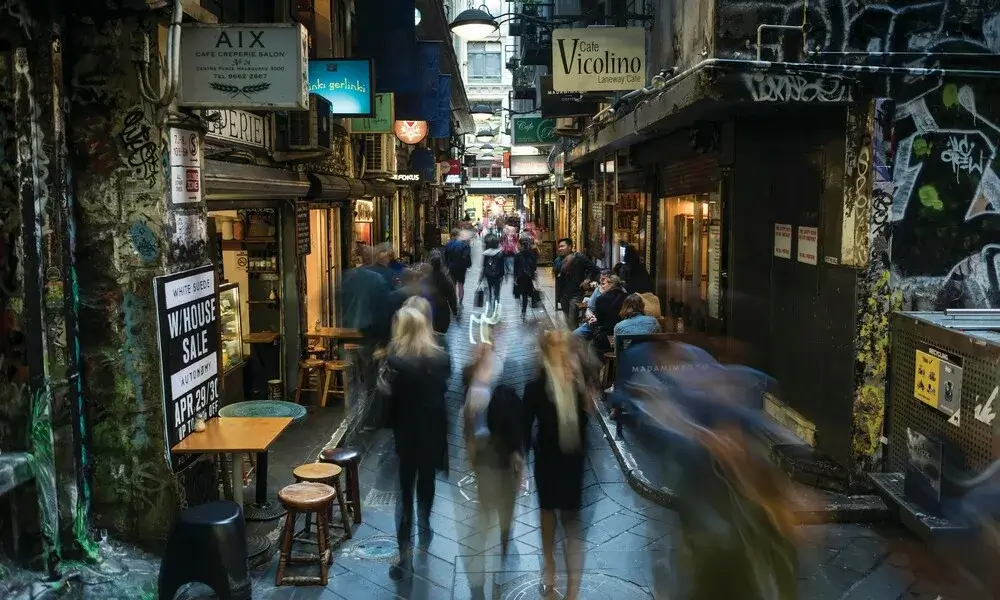
No conversation about vintage-style photography in Melbourne is complete without its world-famous laneways. Tucked between skyscrapers and tram lines, these narrow corridors brim with atmosphere. Cobblestones, ivy-covered walls, decades of graffiti, dim lighting, flickering neon, it’s a stage for visual drama.
“The laneways are Melbourne’s darkroom,” says Nick. “They teach you to see light, shadow, and silence differently.”
His approach here is slow and deliberate. He might walk the same 200-metre stretch four times, watching how the light bounces, how the space breathes as people pass through.
Top Spots:
- Hosier Lane: For contrast-heavy black-and-white shots that bring out texture in mural-covered walls.
- Centre Place: For dynamic candid portraits and ambient lighting from shopfronts and café signs.
- ACDC Lane: Grittier, tighter, moodier, perfect for fast film and moody grain.
Film Pairing: Portra 800 or Cinestill 800T, ideal for shadowy conditions, neon signs, and twilight detail.
Nick’s Tip: Use reflective surfaces and puddles to build layers. Shoot wide open at f/2 or f/2.8 to isolate movement in the frame.
Analogue Meets Architecture: How Vintage Film Complements Melbourne’s Built Identity
Nick Karagiannis often speaks about how certain cities “wear” film better than others, and Melbourne is one of them. Why? Because its architecture isn’t just visual. It’s textural. From the federation homes and cast-iron verandahs to industrial-era warehouses and Art Deco shopfronts, Melbourne offers a structural story that 35mm and medium format film elevate with unique sensitivity.
“Film reacts to surfaces with nuance,” Nick says. “You shoot a metal roller door in Brunswick, and Portra 160 brings out its faded history, the dents, the rust, the quiet wear.”
In digital, these small surface shifts can be flattened or over-corrected. But with vintage cameras and analogue film, Melbourne’s buildings become characters, not just backdrops.
Nick often chooses:
- Ilford FP4 for capturing stone textures and shadow play in high-contrast settings like laneways or underpasses.
- Kodak Ektar for red brick tones in Fitzroy and warm highlights on old sandstone buildings in the city’s fringe.
- Portra 400 when photographing entire streetscapes in changing cloud cover, allowing for colour balance without losing depth.
Pair this with manual lenses from the 70s or 80s, and the imperfections, vignetting, subtle blur, and natural distortion bring Melbourne’s timeless architecture to life.
“Melbourne’s style isn’t clean,” Nick explains. “It’s storied. And film, by nature, respects a good story.”
Nick’s Guide to Vintage Colour Tone Shooting in Melbourne
For those looking to lean into the vintage aesthetic, Nick Karagiannis shares several practical tips on achieving natural, nostalgic tones, especially in a city like Melbourne, where the colour temperature can change quickly.
Shoot in Soft Light
Overcast days in Melbourne act like a giant softbox. This reduces harsh contrast and gives Portra or Gold films a chance to show off their pastel capabilities.
Avoid Overediting
Nick avoids digital saturation boosts or high-contrast scans. “Let the film breathe,” he says. “The beauty is already there.”
Look for Old Signage & Materials
Rust, stone, paint layers, and metal gates, Melbourne offers endless textured backdrops that scream character. Focus on surfaces that wear time visibly.
Use Manual White Balance for Scanning
When scanning your negatives, avoid auto-corrections. Keep the whites warm, and preserve the yellows; it enhances the timeless feel without going into artificial sepia tones.
Nick goes deeper into his post-production advice in the 35mm Film Photography Guide, particularly for those using home scanning setups or hybrid workflows.
The Photographer’s Mindset: How Melbourne Changes the Way You Shoot
Melbourne isn’t just a beautiful city, it’s an emotional one. The way light filters through laneways, how a tram casts shadows down an empty road, or how a still moment appears between busy street corners, it demands a different kind of attention.
Nick Karagiannis believes Melbourne trains the eye to shoot more intuitively.
“In Sydney, you’re often reacting to big lights. In Melbourne, you’re reacting to stillness, to tone, shape, and emotional charge,” he says.
This shift influences everything from gear selection to frame rate. With fewer frames per roll, Nick leans into a slower rhythm. He may walk a suburb like Fitzroy for over an hour before taking a single photo. The act becomes meditative.
What Melbourne Teaches Analogue Shooters:
- To Compose Intentionally: With every alleyway holding potential, it teaches you to wait, to frame, and to rethink the obvious angle.
- To Respect the Light: The city’s shifting cloud cover and muted skies force photographers to be light-aware, not just scene-aware.
- To Embrace Imperfection: Flare, grain, soft focus, these aren’t mistakes here. They’re part of the mood.
“Melbourne rewards you for looking twice. It doesn’t scream for attention. It waits for a connection.”
This mindset is something Nick integrates into his mentoring and 1:1 sessions, particularly for digital photographers making the shift to film. As he says, “You don’t shoot Melbourne, you listen to it.”
When in Melbourne, Pack the Right Tools
Melbourne’s unpredictability, both in weather and light, means it rewards readiness. Nick Karagiannis always brings:
- A fast 50mm lens
- One roll of high-speed film (Portra 800 or Delta 3200)
- One fine-grain option (Portra 160 or FP4)
- A lightweight tripod or mini flexipod (for long-exposure in the laneways)
“I never regret being over-prepared in Melbourne,” he laughs. “The light changes every ten minutes, but the stories never stop.”
Nick Karagiannis: Why Melbourne Feels Like Film
Nick Karagiannis insists that Melbourne isn’t just good for film, it feels like film. Its streets aren’t overly polished. They’re real. Worn. Weathered. Full of mood and possibility.
“Sydney reflects. Melbourne absorbs,” he explains. “It gives back atmosphere, not sparkle. That’s why it’s such a powerful place to shoot vintage-style photography.”
For Nick, walking these suburbs isn’t just about getting the shot. It’s about noticing, the way the bricks curve, the sound of a passing tram, the smell of coffee rising from alley cafés. Melbourne slows you down and opens your eyes.
Ready to Explore Melbourne’s Vintage Side?
Whether you’re travelling from Sydney, local to Victoria, or visiting Australia for the first time, Melbourne’s inner suburbs offer an unparalleled canvas for film photography.
To see how Nick shoots these locations in real time, explore his Vintage Camera Collection and ongoing visual essays in the Australian Nick Karagiannis blog.
Want help planning your next shoot or exploring Melbourne with vintage gear in hand? Contact Nick Karagiannis directly, whether for advice, mentorship, or to join an upcoming Melbourne photo walk.
Conclusion: Melbourne Through the Film Lens
For Nick Karagiannis, Melbourne is more than just a photogenic city; it’s a place that invites stillness, patience, and story-driven photography. The suburbs he’s explored aren’t just backdrops; they’re collaborators in the frame. Every textured wall, tram shadow, and muted skyline offers an opportunity to see the world not just as it is, but as it feels.
Film photography in Melbourne isn’t about chasing perfection. It’s about leaning into mood, letting go of control, and responding to what the city offers in its own time. Whether you’re a seasoned film shooter or new to the craft, Melbourne’s streets will reward you for slowing down and seeing with intention.
As Nick often says, “You don’t need a perfect setup or the best gear. Just bring a good roll of film, walk with purpose, and let the city reveal itself.”
So pack your favourite vintage camera, a couple of trusted film stocks, and start your walk, because in Melbourne, the photograph finds you.