Capturing the Colours of the Australian Outback on Kodak Ektar
Nick Karagiannis is no stranger to subtlety. He’s spent years exploring film’s quieter moments: soft window light, grey coastal mist, shadows in the rainforest. The Australian Outback is more than just red dirt. It’s a dynamic, colourful environment full of bold landscapes, incredible textures, and intense natural light.
Whether you’re photographing the glowing monolith of Uluru, the rugged ridges of Alice Springs, or the surreal formations of Karlu Karlu, using Kodak Ektar 100 will help you bring these vibrant landscapes to life on film.
Why Kodak Ektar is Perfect for the Australian Outback
Kodak Ektar is a colour negative film known for its ultra-fine grain and vivid saturation. It performs especially well in bright light, making it the ideal stock for Australia’s desert regions. In the Outback, Ektar’s deep blues, warm reds, and crisp details give your photographs richness and depth that digital often struggles to match.
You’ll find it especially handy in scenes with large dynamic ranges, where highlights and shadows compete. Ektar allows you to preserve contrast without sacrificing colour accuracy, which is a common challenge in the Outback’s intense midday light.
Top Australian Outback Locations to Shoot on Ektar
Uluru (Ayers Rock)
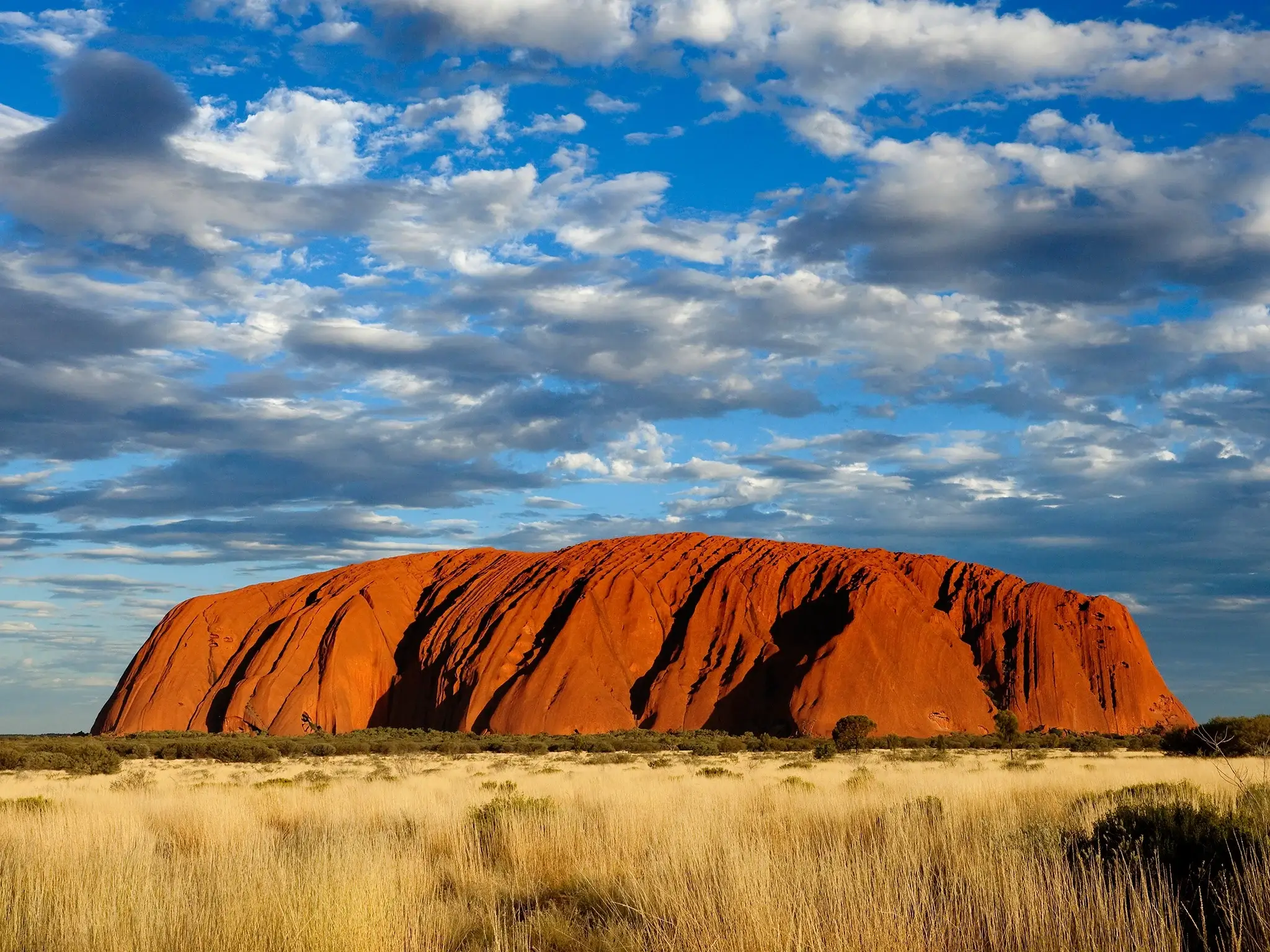
One of Australia’s most iconic sites, Uluru, changes appearance throughout the day depending on the light. Early morning and late evening provide soft shadows and rich tones that Ektar enhances beautifully. It is not just a must-see, but a must-photograph Outback location for anyone shooting film.
What Nick Saw Through the Viewfinder:
Deep, burnt orange at sunset, with shadows stretching like brushstrokes
Soft rose and violet hues in pre-dawn stillness
Harsh midday contrast defining ancient rock fissures
Occasional bursts of green life against glowing sand
“Uluru isn’t just a subject — it’s a collaborator,” Nick says. “It tells you when it’s ready.”
Best Times to Shoot:
Dawn (blue hour into first light) for subtle tonal gradients
Dusk (golden hour to civil twilight) for Ektar’s true saturation potential
Nick’s Kit:
Nikon F2 + 50mm f/1.8
Ektar 100 rated at box speed
Tripod with low angle positioning for stable, heat-resistant capture
Circular polariser (used sparingly) to manage sky glare
Uluru’s most powerful images weren’t the wide shots. Nick often focused on small formations, erosion lines, and transitions between shadow and glow. Some of these appear in his desert series Heat Memory, featured in the Nick Karagiannis blog.

Alice Springs and the MacDonnell Ranges
While Uluru offers grandeur, Alice Springs and the nearby MacDonnell Ranges offered Nick something equally powerful: texture.
From the winding roads of the West Macs to ghost gum silhouettes against ochre cliffs, the light here shifts fast, bouncing off pale stone and heat haze, then cooling as dusk sinks into the gorges.
Visual Priorities in the MacDonnell Ranges:
Capturing the fine tonal shifts in red earth and pale spinifex
Isolating shadows on cliff faces and crumbled rock
Shooting midday shadows in dry creek beds for contrast
“This is where Ektar shines,” Nick explains. “It brings clarity to chaos. Every rock, every line, every dry grass blade — you can feel them.”
Locations Nick Focused On:
Simpsons Gap – High-contrast cliff faces with perfect light separation
Ormiston Gorge – Water still enough to mirror sky and rock
Standley Chasm – A narrow canyon flooded with midday light for 20 minutes
Gear and Technique:
Pentax Spotmatic + 28mm f/3.5
Tripod for gorge reflections
Spot metering for rock shadows
Ektar’s daylight latitude handled both high exposure and shade transitions beautifully
Nick processed these rolls with minimal correction. “The film knows how to see this light,” he says.
These frames now sit within the Australia Nature Photography archive as some of his most finely textured Outback captures.
Colour as Presence
Both Uluru and the MacDonnell Ranges taught Nick that colour in the Outback isn’t an aesthetics, it’s presence. It signals age, temperature, space. And with Ektar, that presence translates without dilution.
“You don’t need to saturate. You need to witness,” he says. “Ektar does the rest.”
Kings Canyon (Watarrka National Park)
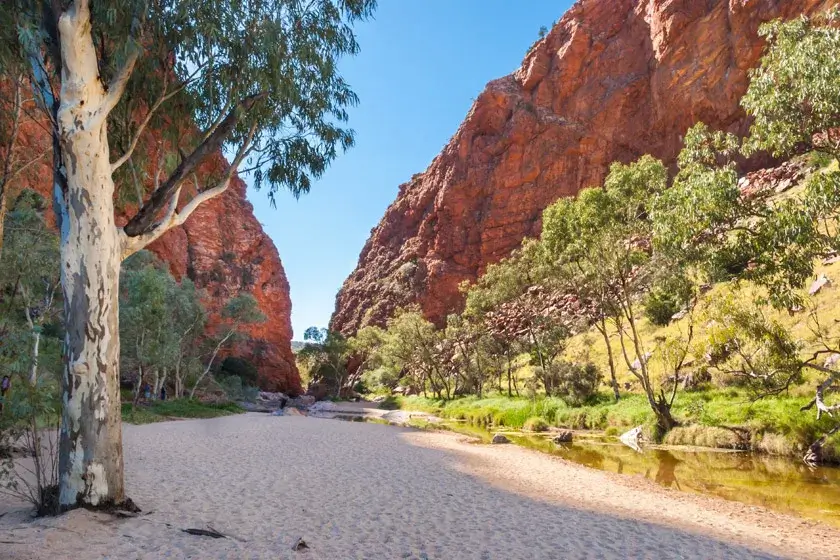
Tucked within Watarrka National Park, Kings Canyon was one of the most demanding, and visually striking, places Nick Karagiannis photographed during his Outback journey. Unlike Uluru’s solitary presence or the soft textures of the MacDonnells, Kings Canyon is all about structure: stacked stone, weathered cliff faces, and vertiginous ledges.
“Kings Canyon teaches you that land can be sculptural,” Nick says. “It feels like walking through an ancient design.”
What Nick Focused On:
Light slipping into crevices during sunrise on the rim walk
Patterns in eroded domes and fossil-textured ledges
Bright plants piercing through stone with unnatural vividness
Reflected light in canyon interiors, warming the shadows with gold
Shooting Approach:
Ektar 100 rated at 100 to preserve colour fidelity in highlights
Leica M3 with 50mm lens for tight compositions
Soft ND grad filter on high-contrast horizons
Shooting pre-10am or post-4pm to avoid flattening highlights
Some of Nick’s most layered colour compositions came from a shaded lookout on the southern rim, where red rock, blue shadow, and green spinifex converged.
“It was the first time a photo actually felt hot,” he recalls.
Several Kings Canyon sequences were later developed into the visual series Stone Maps, featured in the Nick Karagiannis blog.

Devils Marbles (Karlu Karlu)
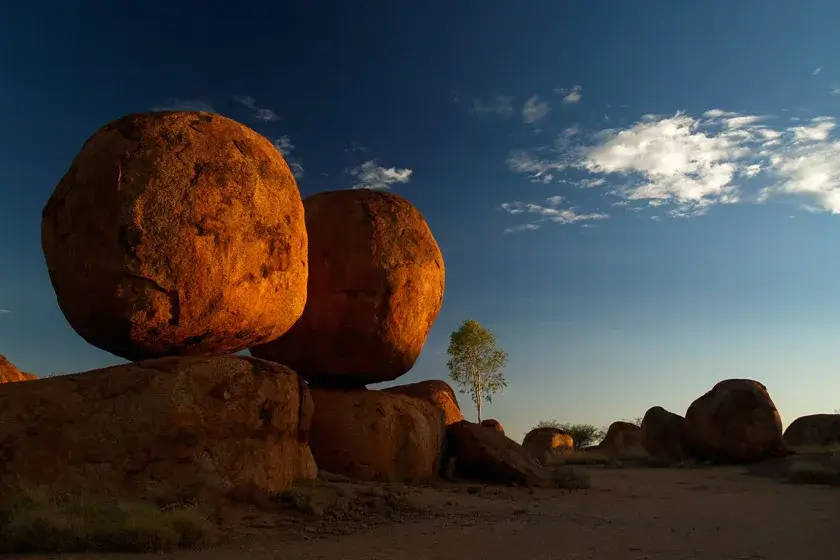
In the open vastness between Alice Springs and Tennant Creek, a strange shape rises from the land: Devils Marbles, or Karlu Karlu, a sacred Aboriginal site of precariously balanced granite boulders. It was here that Nick Karagiannis found both artistic contrast and emotional weight.
“These weren’t just rocks. They were watching you,” he says.
The site’s simplicity demanded restraint. Every step shifted the perspective. Every ray of sunlight added or removed definition.
What Stood Out:
Spherical balance against flat earth
Pink-orange stone under blue twilight
Cracks and grooves catching last light
Long shadows stretching into emptiness
Nick’s Setup:
Ektar 100, no filters, rated at box
Canon AE-1 + 35mm lens for flexible wide framing
Handheld light readings from granite to preserve natural tone
Nick avoided wide, obvious tourist-style shots, opting instead for tight abstracts — boulder edges, lichen blooms, and shadowed space.
“It’s one of the few places where the silence feels loud.”
Many of these frames became part of his Desert Geometry collection, used in exhibition prints and portfolio reviews within the 35mm Film Photography Guide.
Outback Colour Theory – Working With (Not Against) Intensity
Nick Karagiannis treats the Outback’s colour not as a gimmick, but as a character. With Kodak Ektar, he works to balance heat and clarity without over-saturating or flattening detail.
His Tips for Managing Outback Colour with Ektar:
Expose for highlights – Ektar can handle shadows, but once highlights blow, they’re gone
Don’t fight the warmth – Let reds and oranges speak; balance comes from blue sky or ground cover
Use shadow as anchor – Harsh colour feels calmer when framed with negative space
Overcast skies? Embrace texture – Even without sun, Ektar finds shape in muted earth tones
“Out here, colour is narrative. Ektar doesn’t dramatise it. It translates it.”
The Emotional Contrast of the Desert
While Ektar thrives on physical boldness, Nick believes it also reveals the emotional contrasts of Australia’s red centre, where wide space often heightens intimacy and solitude.
“You think the desert is about vastness. But the real story is in how small you feel.”
His photography in the Outback wasn’t loud. It was quiet, deliberate, and often melancholic. The vivid colours told stories of time, erosion, memory, and breath.
In workshops and conversations, Nick often shares these moments, standing still at sunrise, lying on warm rock, waiting for the wind to stop, as essential parts of his Nick Karagiannis nature photography tips.
Best Times of Day to Shoot
Morning (6:00–9:00 am): Soft light with cooler tones and long shadows.
Late Afternoon (4:00–6:30 pm): Golden warmth, lower contrast, and excellent light for portraits or wide landscape shots.
Midday: Harsh, bright light. Useful if you are intentionally trying to capture the stark, high-contrast look that Ektar excels at.
Tips for Shooting Film in the Australian Outback
Bring a polarising filter to enhance skies and cut glare from dusty surfaces.
Bracket your exposures if you’re unsure. Ektar is flexible, but exposure latitude is still limited compared to digital.
Protect your gear from sand and heat. A lens cloth and blower are essential, as are zip-seal bags or a padded film case.
Consider medium format for higher detail in wide landscapes, especially at places like Uluru and Kings Canyon.
Essential Gear Checklist
Extra batteries and film rolls
Tripod or monopod for sunrise and sunset shots
Lens blower and cloth
3 to 5 rolls of Kodak Ektar 100, or more if you’re travelling long distances
Nick Karagiannis: Ektar, the Outback, and the Gift of Boldness
Ektar isn’t for every subject. But for the Outback, where heat, colour, and age pulse through the land, it’s unmatched. For Nick Karagiannis, the film’s ability to meet this land on its own terms makes it a lifelong companion.
“The Outback doesn’t just demand a camera. It demands respect. Ektar is how I show that.”
Ready to Photograph Australia’s Red Centre?
Nick recommends starting with:
One camera
Two lenses (a wide and a normal)
6–10 rolls of Ektar 100
An open schedule and quiet pace
To see more of Nick’s desert work, visit the Australia Nature Photography gallery or explore field essays and film insights in the Nick Karagiannis blog.
Want help planning your first Outback photography trip? Contact Nick Karagiannis for mentoring, gear tips, and slow-shooting strategies, wherever you are in Australia.
Frequently Asked Questions About Shooting Kodak Ektar in the Australian Outback
Why does Nick Karagiannis use Kodak Ektar for desert photography?
Nick uses Kodak Ektar 100 because of its unmatched ability to render bold colours, especially reds, oranges, and deep earth tones — all key to Australia’s central landscapes. Ektar’s fine grain and daylight-optimised profile make it ideal for harsh, bright conditions without sacrificing detail.
“Ektar doesn’t just capture colour. It honours it,” Nick says.
What are the best times of day to shoot in the Outback?
Nick recommends:
Golden hour (just after sunrise or before sunset) for soft warmth and long shadows
Blue hour for cooler, balanced exposures
Mid-morning (with caution) if seeking strong contrast and raw terrain details
Avoid mid-day unless specifically chasing harsh light effects — the risk of overexposure is high with Ektar.
Can I use Ektar 100 handheld, or do I need a tripod?
Ektar 100 is a low-speed film, so Nick suggests:
Handheld in bright daylight with lenses f/2.8 or faster
Tripod during golden hour, in canyons, or for fine compositions at f/8 or higher
A tripod also helps maintain stability in wide-open, windy areas like Uluru or Kings Canyon.
Which lenses work best for Outback shooting?
Nick favours:
35mm for general landscapes and context scenes
50mm for isolated compositions and mid-distance frames
28mm for tight environments like gorges and canyon interiors
He shoots primarily with manual focus primes to maintain full control over framing and depth of field.
Do I need filters when shooting with Ektar in the desert?
Nick uses:
A circular polariser sparingly — to reduce glare or darken skies without over-saturating reds
A soft graduated ND filter to balance bright skies with darker foregrounds (especially useful in Kings Canyon or at Devils Marbles)
“Let the film do most of the work. Filters should support, not overpower,” he advises.
How should I meter light in harsh conditions?
Spot meter from the highlights (e.g., sunlit rock) and underexpose slightly to preserve sky and surface texture
Avoid averaging between sky and land — Ektar’s dynamic range is limited compared to negative film like Portra
Nick often exposes for texture, not tone, and recovers shadows in post only if necessary.
Can Ektar handle overcast desert days?
Yes, though less dramatic, cloudy skies can reveal subtle hues in stone and sand. Ektar retains depth even in flat light and works well for moody, textural compositions in places like Ormiston Gorge or Devils Marbles on overcast afternoons.