Nick Karagiannis Film Pick: Why Ilford Delta 3200 Excels in Low Light
 Photo by Annie Spratt on Unsplash
The Night Is a Canvas, If You Know How to Shoot It
Nick Karagiannis has spent years refining his craft behind the lens, chasing light across Australia’s vast terrains, from coastal sunrises to city twilight. But for him, few challenges offer the same reward as shooting in low light. When the sun dips and the shadows stretch long, Nick sees potential, not limitation. And when it comes to capturing that world of whispers, reflections, and muted tones, one film rises to the top: Ilford Delta 3200.
While Sydney’s golden hour scenes often earn the spotlight, Nick argues that the city truly reveals itself after dusk. “There’s a poetry in low light,” he says. “It strips everything back, colour, distraction, and forces you to focus on form, texture, and emotion.”
It’s this philosophy that drew him to Ilford Delta 3200 in the first place. As one of the fastest black-and-white films available, it allows for handheld shooting in conditions many would deem unworkable. But speed is only part of the story. What makes this film exceptional, in Nick’s view, is how it renders darkness not as emptiness, but as atmosphere.
Understanding Ilford Delta 3200
What Is It?
Ilford Delta 3200 is a high-speed panchromatic black-and-white film designed for low-light and indoor photography. While its box speed is listed at ISO 3200, Nick, like many experienced photographers, notes that it performs best when shot at ISO 1000–1600 and pushed during development. “You get a balance of speed and richness,” he says. “It doesn’t just brighten shadows, it adds weight to them.”
Why It Matters
Most film stocks struggle in conditions without ample natural light. Grain becomes excessive, contrast suffers, and images lose detail. But Delta 3200 handles these challenges with surprising grace. Its tonal range remains impressive even at high ISOs, allowing photographers to retain subtle detail in shadows while embracing the texture that low light inherently brings.
According to Nick Karagiannis, Ilford Delta 3200 isn’t about hiding the dark; it’s about showing how beautiful it can be.
Shooting Sydney by Night: Ilford Delta 3200 in Action
Nick’s love affair with Ilford Delta 3200 began on a rainy evening in Sydney’s inner west. Streetlights glowed through the mist. Wet asphalt shimmered. And everywhere, reflections, movement, and story. Using his Nikon F3, a regular from his Nick Karagiannis vintage camera collection, he loaded Delta 3200 and walked without expectation.
“The results floored me,” he recalls. “The shadows had dimension. Faces weren’t blown out under fluorescents. And the grain? It added soul, not noise.”
That session turned into a series. Over weeks, Nick revisited Darlinghurst alleyways, Newtown shopfronts, and late-night Bondi cafés, all shot in natural light, handheld, on Ilford Delta 3200. The consistent theme? Atmosphere over perfection.
“I wasn’t trying to ‘win’ Instagram,” he laughs. “I was chasing a feeling. And this film let me do that.”
 “Chinon CE-4 Ilford Delta 3200 Scotland Glencoe 001” by Miles Davis (Smiley) is licensed under CC BY-NC-ND 2.0
Why Ilford Delta 3200 Works for Australian Photographers
Australia is known for its vibrant light, searing sun, and crisp skies. But Nick argues that the country’s nightscape is deeply underrated. Cities like Sydney, Melbourne, and Brisbane transform after sunset, revealing their textures in new ways.
“Low-light film photography isn’t just for Europe or moody winters,” Nick says. “In Australia, it gives you access to moments others miss, train platforms at midnight, neon signs buzzing in back lanes, soft lit interiors where stories unfold quietly.”
The film’s fast speed lets you shoot handheld without sacrificing depth. For Australian photographers who value spontaneity, particularly those working in unpredictable urban environments, this flexibility is priceless.
And it’s not just about gear. It’s a mindset. As Nick notes in his 35mm Film Photography Guide, “Your film choice should reflect how you want the world to feel, not just what you want it to show.”
Nick Karagiannis’s Low-Light Workflow: From Exposure to Development
Choosing the Right Settings
Nick rarely shoots Ilford Delta 3200 at box speed. “ISO 3200 is helpful in pitch black, but for balance, I often shoot at 1600 or even 1000,” he explains. This gives him more latitude in the highlights and reduces the risk of blown-out details in scenes with mixed light.
A typical Bondi evening frame might be shot at:
- ISO: 1600
- Aperture: f/2.8
- Shutter: 1/60 handheld
- Lens: 50mm prime
This setup gives just enough depth while keeping his frame responsive to sudden movements or shifting ambient light.
Development Advice
Nick recommends pushing Ilford Delta 3200 in development when shot at higher speeds. “You can comfortably push it one or two stops. Just know that you’re inviting grain to the party, and that’s a good thing.”
For home developers, he suggests using Ilford Microphen or DD-X to retain shadow detail and maintain consistent contrast. “Rodinal gives punch, but it can exaggerate grain to the point of distraction with Delta.”
Scanning & Post
When digitising Ilford Delta 3200 negatives, Nick uses a flatbed scanner with minimal sharpening and contrast. He wants the natural falloff between tones to remain soft. In post, he avoids excessive digital noise reduction. “You chose film for its soul, don’t smooth it into silence.”
Embracing Grain: Why Texture Is Emotion
One of the most polarising aspects of Delta 3200 is its visible grain. But for Nick, that’s not a flaw, it’s the film’s fingerprint.
“In a digital world obsessed with clean pixels, grain reminds us we’re working with light and chemistry,” he says. “It’s emotional texture.”
The grain in Delta 3200 isn’t chaotic. It’s patterned, deliberate, and changes depending on exposure and developer. It adds movement to still frames. And when printed large, it creates a sense of depth that flat digital files rarely match.
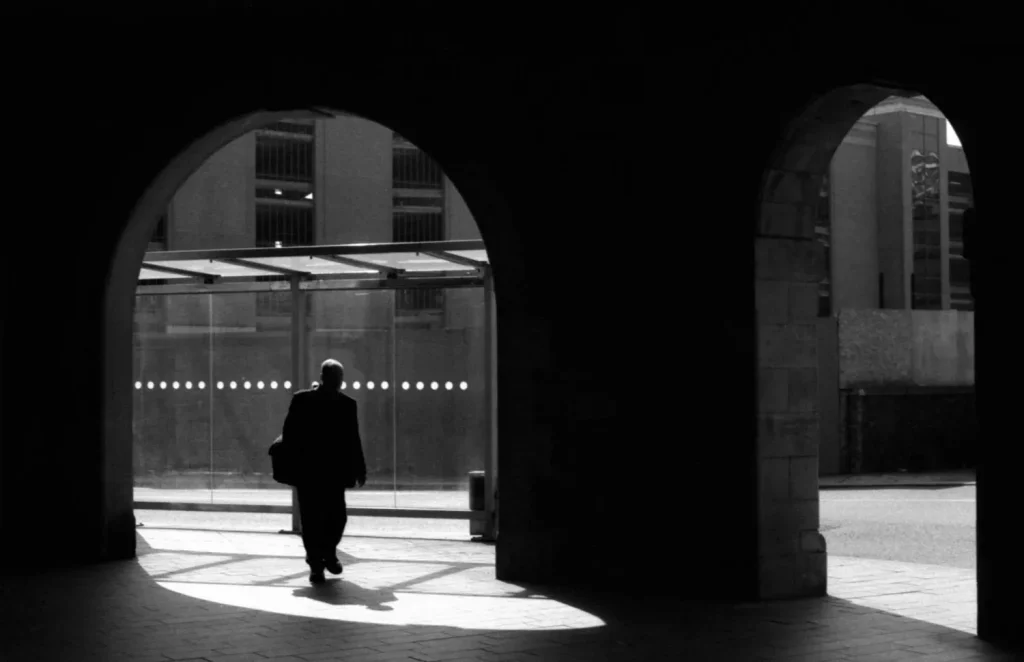
Nick’s favourite Delta print, a silhouette of a man waiting at a bus stop, lit only by the red of a nearby shop sign, hangs in his studio. “Every speck of grain is a heartbeat,” he says. “You don’t clean that out. You let it breathe.”
From City Streets to Coastal Dusk
While most photographers associate Delta 3200 with urban scenes, Nick Karagiannis has also used it successfully in low-lit coastal environments. On the edge of Sydney’s eastern cliffs, just past Watsons Bay, he shot twilight sea spray with Delta loaded into his Olympus OM-1. The result? A hauntingly soft portrait of tide against rock, the grain giving the ocean’s movement a painterly finish.
“Shooting seascapes at night is risky,” Nick admits. “You don’t get forgiveness. But Delta lets you bend that rule a little, enough to explore the edges.”
He pairs this technique with lessons drawn from his Australian nature photography work, bringing emotion to what is usually a daylight-only subject.
Ilford Delta 3200 vs. The Competition: What Sets It Apart?
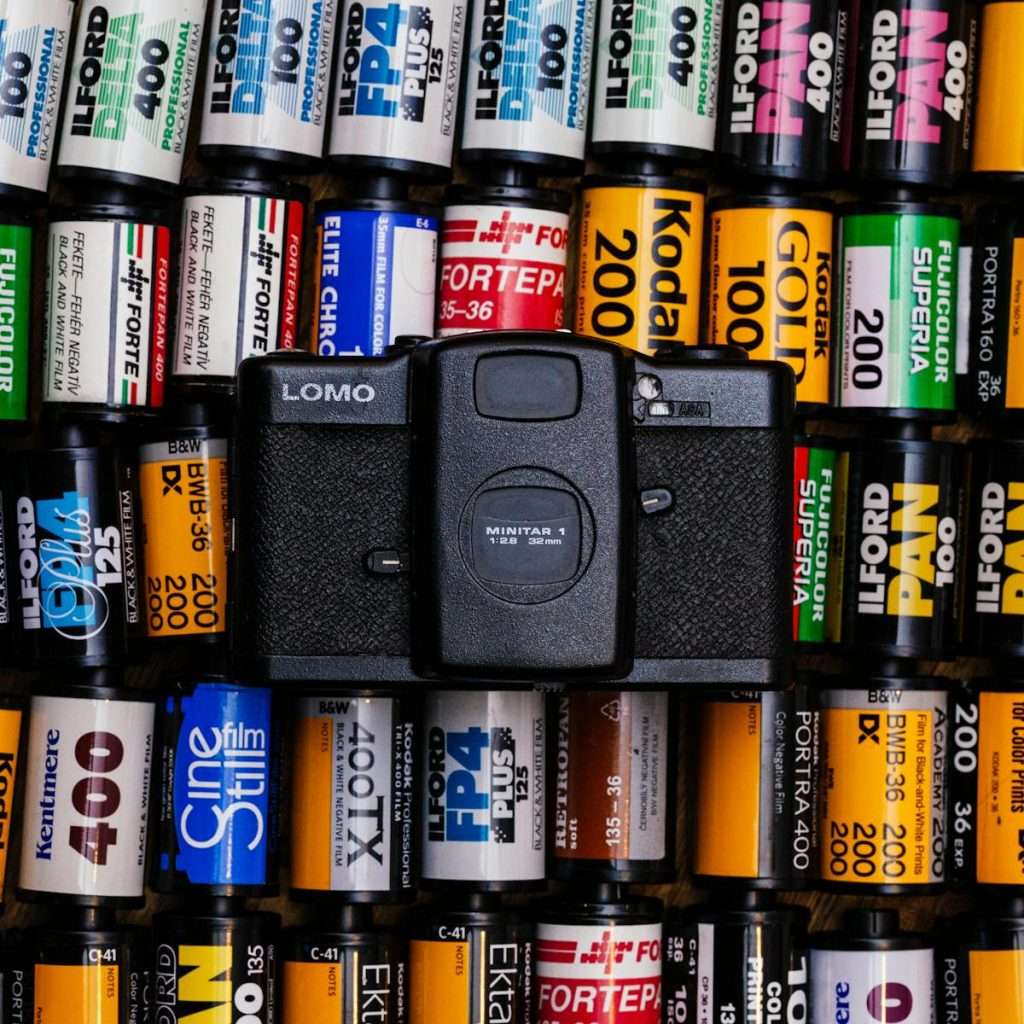 Photo by Balázs Benjamin on Pexels
For Nick Karagiannis, Ilford Delta 3200 3200 isn’t just a practical choice, it’s an artistic one. But how does it hold up against other fast black-and-white films on the market?
Kodak T-Max P3200
Kodak’s direct competitor is T-Max P3200, another high-speed, low-light B&W film. While T-Max offers finer grain and slightly more shadow detail at high ISOs, Nick finds it lacks the “character” he gets from Ilford Delta.
“T-Max is technically superb,” he explains. “But Delta feels more analogue, it responds with grit, not gloss.” He reserves T-Max for cleaner architectural shots where precision matters, but for mood-driven work, like portraits at night or foggy street corners, Delta is his go-to.
Pushed HP5 Plus
Some photographers prefer pushing Ilford HP5 to 1600 or 3200. Nick has done this too, but finds the contrast can become too harsh, and shadow retention suffers.
“Pushed HP5 is aggressive,” he says. “Delta, by contrast, feels like it’s built for the dark. There’s less strain on the frame. You don’t feel like you’re forcing the image out of the shadows.”
In short, if you’re planning to shoot regularly in dim interiors, candle-lit cafés, or shadowy nature, Delta 3200 will outperform most options in how it feels, not just how it looks.
From Personal Shoots to Gallery Walls
Ilford Delta 3200 isn’t just part of Nick’s casual kit; it has played a defining role in some of his most celebrated exhibitions across Australia.
In 2024, his monochrome collection Afterlight opened in Sydney’s inner-city Surry Hills gallery. Nearly half the photographs in the show were captured on Delta 3200, handheld, in low light, printed large-format. Viewers frequently mistook them for digital black-and-white edits, stunned at the smooth transitions between tones and the tactile presence of grain.
“There’s something haunting about Delta on paper,” Nick says. “When printed properly, it feels like charcoal or memory, something fragile but strong.”
The exhibition, which explored urban solitude in Sydney and Melbourne, was later picked up by a Brisbane gallery, reinforcing the idea that Delta 3200 doesn’t just perform, it resonates.
Tips for New Film Photographers Venturing Into the Dark
Low-light film photography can be intimidating, especially for those used to shooting during golden hour or under perfect daylight. But Nick Karagiannis believes it’s one of the most rewarding areas to explore, particularly if you’re using a film like Delta 3200.
Here’s what he suggests for those starting out:
Trust the Grain
Don’t try to eliminate it. Embrace it. “Your first instinct will be to overexpose to keep things smooth,” Nick warns. “But Delta’s magic lives in the grain. Let it do its thing.”
Start at ISO 1600
Rather than jumping straight to 3200, begin by rating Delta at ISO 1600 and pushing one stop during development. This gives you more highlight control and helps you understand the film’s mid-range behaviour before pushing it to extremes.
Keep a Steady Hand (or a Fast Lens)
You don’t need a tripod for Ilford Delta 3200 to shine, just a camera with a smooth shutter and a lens with at least an f/2.8 aperture. Many of Nick’s night shots are taken at 1/60 or 1/125 with a 50mm f/1.8 or f/2.
Choose the Right Locations
Look for places with mixed light sources: neon, streetlamps, candlelight, even illuminated vending machines. Delta handles varying colour temperatures beautifully and turns the scene into a monochrome dreamscape.
Nick’s Favourite Delta 3200 Cameras (Vintage & Modern)
From his Nick Karagiannis vintage camera collection, several models stand out as ideal Delta companions:
- Nikon F3 – A tank with excellent metering and durable enough for any condition.
- Olympus OM-1 – Lightweight and perfect for handheld low-light sessions.
- Leica M3 – When Nick wants precision and the quiet click of a mechanical shutter.
- Canon AE-1 – Widely available, reliable, and beginner-friendly.
For those using modern gear, Ilford Delta 3200 also performs well in hybrid workflows where film is scanned and tweaked digitally. “Just because you shoot film doesn’t mean you can’t embrace post-production,” Nick notes. “The goal is to honour the feeling, not stick to purist rules.”
Why Delta Reflects Nick’s Philosophy
At its core, Ilford Delta 3200 mirrors Nick Karagiannis’ entire creative approach: imperfect, expressive, and responsive to the moment.
He doesn’t shoot for flawless edges or perfect lighting. He shoots to remember, to give himself and his viewers a sense of what it felt like to be in that street, with that sky, in that flicker of time.
“Photography isn’t about perfect conditions,” he says. “It’s about trust. Trusting your film, your gear, your instincts. Delta 3200 helps you do that. It doesn’t just record the dark, it listens to it.”
That’s the kind of film that sticks with you. And that’s why, even as new emulsions come and go, Nick always keeps a roll or two of Delta 3200 in his bag, ready for the next night that speaks.
Ready to Shoot the Night?
If you’re curious to start your low-light film journey, Nick recommends beginning close to home. Head out just after sunset. Find a quiet corner in your city. Load a roll of Delta 3200. And let the shadows shape the shot.
For more tips on film choice, camera setup, and post-processing workflows, check out the detailed 35mm film photography guide , especially the section on high-ISO shooting and push development.
Want personal advice or to share your first Ilford Delta 3200 roll? Reach out via the contact page. Nick is always happy to hear from fellow film enthusiasts exploring Australia’s hidden light.
And if this article inspired you, read more about this topic in Nick Karagiannis’ blog, where he shares his thoughts on gear, process, and the emotional depth behind every frame.
FAQ: Shooting with Ilford Delta 3200 – Nick Karagiannis’ Low-Light Film Essentials
Q: What makes Ilford Delta 3200 ideal for night photography?
A: Its ultra-high sensitivity (ISO 3200) makes it perfect for shooting handheld in low-light conditions. Nick Karagiannis values how it captures detail and emotion without a tripod, especially in moody Australian cityscapes and night street scenes.
Q: Does Nick shoot Ilford Delta 3200 at box speed (ISO 3200)?
A: Rarely. Nick prefers shooting Delta 3200 at ISO 1000–1600 and pushing during development. This gives smoother tonal transitions and better highlight control while still preserving the film’s trademark grain and atmosphere.
Q: What’s Nick’s go-to camera setup when using Delta 3200?
A:
Camera: Nikon F3 or Olympus OM-1
Lens: 50mm f/1.8 or f/2
Settings: ISO 1600, f/2.8, 1/60s handheld
This setup is lightweight, responsive, and ideal for urban walks through places like Darlinghurst or late-night Bondi cafés.
Q: What kind of developer does Nick recommend for Ilford Delta 3200?
A: For best results, Nick recommends Ilford DD-X or Microphen, which preserve shadow detail and moderate grain. He cautions against using Rodinal with Delta unless you specifically want gritty contrast, as it can exaggerate grain too heavily.
Q: How does Ilford Delta 3200 compare to Kodak T-Max P3200?
A: While Kodak’s T-Max P3200 is cleaner and offers finer grain, Nick finds Delta 3200 more emotional and analogue in feel. He chooses Delta when mood and texture matter more than sharpness, especially for portraits, foggy scenes, and dim interiors.
Q: Can Ilford Delta 3200 be used for non-urban photography?
A: Yes. Nick has used it for coastal dusk sessions and nature shots along Sydney’s cliffs. Its grain gives sea spray and rock textures a haunting depth, showing that Delta isn’t just for streets—it’s for any space with subtle, shifting light.
Q: What is Nick Karagiannis’ editing process for Ilford Delta 3200 scans?
A: He keeps it simple and respectful of the film’s natural tones. After scanning with a flatbed scanner, he avoids over-sharpening or strong contrast edits. His goal is to maintain soft transitions and highlight the film’s natural grain structure.
Q: Is Delta 3200 a good film for beginners?
A: Absolutely, if you’re comfortable embracing grain and don’t mind experimenting with push development. Nick suggests starting at ISO 1600 to ease into its handling. With basic gear and the right mindset, even newcomers can achieve stunning low-light results.
Q: What’s the biggest mistake beginners make with the Delta 3200?
A: Trying to eliminate grain or overexpose to “clean up” the image. According to Nick, the grain is the emotion. He encourages new photographers to lean into the moodiness and embrace the texture that defines this film’s character.
Q: How does Ilford Delta 3200 reflect Nick’s artistic philosophy?
A: Nick believes photography is about emotional honesty, not perfection. Delta 3200 supports that view by capturing imperfect light beautifully. “It listens to the dark,” he says. It’s a film that records how a moment felt, not just what it looked like.
Q: Where can I see Nick’s work with Ilford Delta 3200?
A: Many of Nick’s most celebrated night images appear in his Afterlight exhibition and throughout the Nick Karagiannis blog. You can also follow his 35mm Film Photography Guide for tips on shooting and scanning Delta in Australian environments.
Q: Can I contact Nick for personal tips or feedback on my Delta 3200 shots?
A: Yes! Nick encourages film enthusiasts to reach out via the Contact Page. Whether you’re trying Delta for the first time or refining your low-light workflow, he’s open to sharing insights and feedback.