Nick Karagiannis Explores Rugged Landscapes & Remote Beauty: Tasmania, Australia
Nick Karagiannis has travelled far and wide across Australia, but few places have spoken to him as deeply as Tasmania. An island of extremes, jagged coastlines, ancient forests, alpine silence, and coastal blaze, Tasmania offers something rare in modern landscapes: untouched solitude.
“Tasmania doesn’t just show you beauty,” Nick says. “It slows you down enough to understand it.”
For Nick, shooting in Tasmania was about more than photography. It was about returning to observation, to weather, to texture. In this article, he shares the locations that shaped his journey and how each landscape invited a different photographic rhythm.
The Character of Tasmania on Film
Tasmania’s natural beauty isn’t loud. It’s subtle and layered. Shooting here on film allows you to embrace the island’s softness, the grain of ancient bark, the reflections in dark glacial waters, and the pastel blues and greys that hang in the sky for hours after sunset.
Nick Karagiannis explores Tasmania not just for its landscapes, but for its feeling. Using a mix of black and white film and muted colour stocks like Portra 160 or Fuji Pro 400H (when it was still available), he lets the scenery speak in tones that digital can’t quite match.
From fog-drenched forests in Mount Field National Park to wind-whipped cliffs at the edge of Bruny Island, each frame conveys a quiet tension, the sense of standing somewhere far from noise, far from distraction, where every rustle of wind or ripple on a lake becomes part of the story.
Key Locations for Film Photography in Tasmania
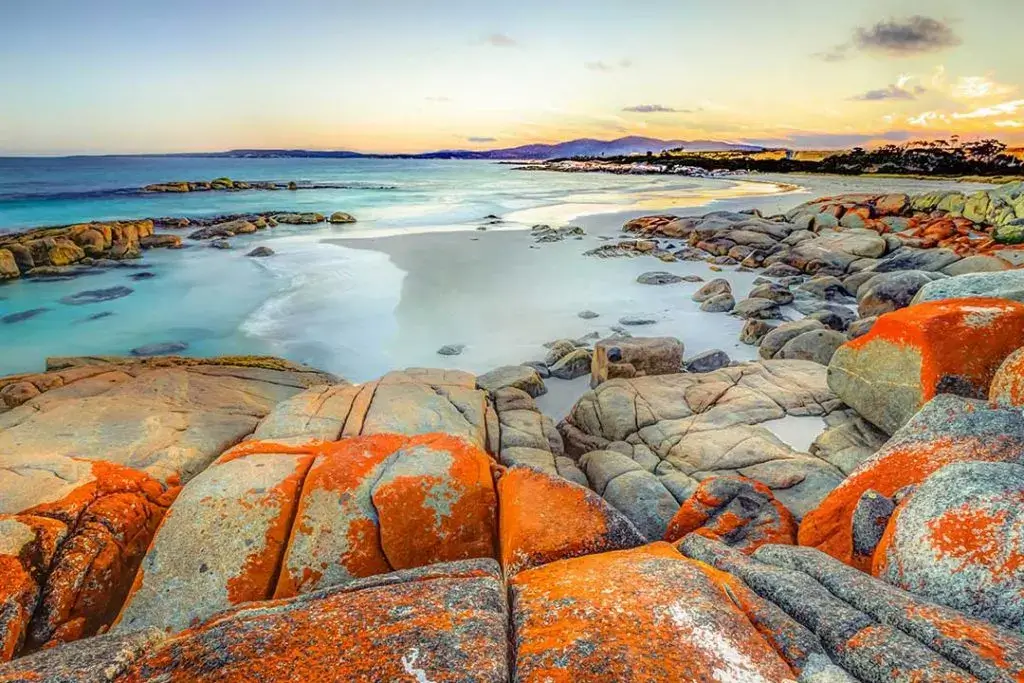
Situated along Tasmania’s northeast coast, the Bay of Fires is a place where granite boulders meet turquoise sea under sprawling skies. But what gives it its name, and its photographic distinction, are the brilliant orange lichen-covered rocks that stretch endlessly along the coast.
“It’s like painting with colour you didn’t expect to find in nature,” Nick explains.
What Nick Looked For:
Contrast between orange rock and blue-green sea
Patterns in tide lines, driftwood, and shadow play
Reflections in tidal pools at golden hour
Silhouettes of lone walkers or birds against high skies
Preferred Film Setup:
Kodak Ektar 100 for vibrant saturation
Leica M3 with a 50mm lens
Low tripod for tide-level compositions and long exposure
Nick recommends shooting here in the early morning or late afternoon, when the colours begin to glow, and the wind slows enough for calm reflections. Some of his most vibrant seascapes in the Nick Karagiannis blog were taken at Bay of Fires, often composed slowly, with long pauses between frames.
Tasmania’s highland heart, Cradle Mountain–Lake St Clair National Park, challenged Nick in unexpected ways. Harsh weather. Stark light shifts. And above all, a kind of stillness that asks you to stop shooting, and start watching.
“The mountains don’t rush you,” Nick says. “They wait to see if you’re paying attention.”
What Mattered in This Landscape:
Light falling across alpine grass at dawn
Mist wrapping around trees and rising rock edges
Water as mirror, capturing still lakes with cloud reflection
The harsh contrast between sunlight and stone
Nick worked mainly with:
Ilford FP4 Plus for high detail and softer contrast
Pentax Spotmatic with a 28mm lens
Neutral filters to preserve sky texture and cloud gradients
He often shot early mornings and post-storm afternoons, using the unpredictable weather to layer mood into the frame.
“If the Bay of Fires is about light, Cradle Mountain is about shadow.”
This national park now features heavily in Nick’s Australia Nature Photography portfolio, where contrast, silence, and slow detail lead the eye.

Located off the southeast coast, Bruny Island is one of Tasmania’s quietest revelations. Accessible only by ferry, it offers both wild coastline and soft farmland, an emotional range that mirrors Nick’s own style.
“It felt like time had folded in on itself. Like I was somewhere in between decades.”
Nick’s Bruny Island Moments:
Mist hanging over rolling fields in the early morning
Seals and seabirds along the rocky edge of The Neck
Long drives through tree-lined roads as fog lifted in beams
Locals reading by windows, light filtered through lace curtains
Tools of Choice:
Portra 160 for pastel skies and skin tones
Olympus XA for pocket-ready candid moments
Notebook for capturing sound, silence, and local fragments to accompany each frame
Bruny wasn’t about drama, it was about presence. Nick describes it as one of the most emotionally grounding locations he’s visited in Australia. “The landscapes are gentle, but they stay with you.”
Many of his film scans from Bruny became part of a sequence called Soft Island, shared in his workshops and featured in the 35mm Film Photography Guide as an example of mood-based storytelling.

Just over an hour from Hobart, Mount Field National Park delivered a completely different kind of beauty to Nick Karagiannis, one that merged the density of rainforest with the crispness of mountain air. Within a few kilometres, you move from towering tree ferns to sub-alpine tarns and snow-grazed peaks.
“Mount Field felt like five landscapes in one. It was hard to leave,” Nick recalls.
What Nick Focused On:
Cascades and flow lines at Russell Falls, captured with long exposure on a low tripod
The contrast between moss-covered trunks and backlight
Snow patterns and skeletal trees around Lake Dobson
Fern spirals, ground-level fungi, and water droplets for texture-rich closeups
Preferred Film Stock:
Ilford HP5 Plus – for the tonal range of wet bark and stone
Kodak Portra 400 – for forest hues under overcast skies
Nikon F2 with 35mm lens – for depth layering and tighter framing
Nick describes Mount Field as one of the most compositionally rich parks in Australia, ideal for those who love capturing nature in close, layered detail.

While Tasmania’s wild landscapes draw most photographers, Nick Karagiannis found equal inspiration in Hobart and its surrounding historic towns. It was here that contrast between old and new, fast and slow, modern grit and colonial decay created visual and emotional tension.
“Hobart reminded me that stillness can live in a city — if you’re willing to walk quietly.”
Where Nick Explored:
Battery Point – early morning walks past sandstone cottages and sleeping windows
Salamanca Market – candid portraits and ephemeral colour
New Norfolk – peeling walls, church shadows, and weathered storefronts
Richmond – sandstone bridges, arched doors, and soft golden light
Cameras in Rotation:
Leica M3 with 50mm Summicron – for capturing quiet architectural lines
Canon AE-1 – for spontaneous street scenes and light shifts
Tri-X 400 and Portra 160 – balancing mood and colour across contrasting environments
Nick’s Hobart images lean towards portraiture — not just of people, but of places. His series Sleepy Brick, captured entirely on foot over three days, is a love letter to light on old walls and the spaces we pass too quickly.

Why Tasmania is Perfect for Australian Nature Photography
Tasmania rewards patience. The weather shifts constantly, the light changes quickly, and the terrain invites you to slow down. Film is well-suited to this. It teaches you to wait for the fog to lift, to listen for the water to still, to trust that a quieter image can often be the most powerful.
Where digital might flatten the island’s moody tones, film embraces them. The greys feel softer. The greens feel older. The black shadows don’t just obscure; they add weight. This is Australian nature photography at its most immersive.
Emotional Presence Over Postcards
In reflecting on his time in Tasmania, Nick Karagiannis describes it not as a photographic destination, but as a personal one. Each place asked something different from him: colour, patience, stillness, contrast.
“I didn’t want postcard shots,” he says. “I wanted memory shots. Feeling shots.”
Rather than chasing dramatic wide angles or tourist checklists, Nick’s focus was on quiet storytelling, letting the land reveal itself slowly, through textures, weather, and time.
This approach now guides how he teaches landscape photography across Australia, especially in mentoring sessions with younger film photographers or those moving from digital.
Nick Karagiannis: Tasmania as a Lens for Self-Discovery
Tasmania didn’t just give Nick Karagiannis some of his most memorable images, it gave him clarity. It reminded him of what photography is when all the noise is stripped away.
“Tasmania isn’t loud. It doesn’t perform. It just waits — for you to catch up.”
For any photographer, amateur or experienced, looking to reconnect with observation, patience, and depth, Tasmania offers the perfect invitation.
Want to Explore Tasmania Through Your Lens?
Nick recommends starting with:
One camera
Two film stocks (one colour, one black-and-white)
A week of slow travel, not itinerary-driven, but light-led
To see more of Nick’s images and essays from Tasmania, visit the Nick Karagiannis blog or learn practical gear and film tips in the 35mm Film Photography Guide.
Ready to plan your own photographic retreat or book a guided mentorship? Contact Nick Karagiannis for suggestions, support, and workshops across regional Australia.
Frequently Asked Questions About Photographing Tasmania with Film
What’s the best time of year to photograph Tasmania?
Nick recommends autumn (March–May) and late spring (October–November). These seasons offer a balance of changing light, cool temperatures, fewer crowds, and rich atmospheric shifts, especially in alpine and rainforest regions.
“Tasmania’s weather is always unpredictable — and that’s part of the charm,” Nick says.
Which film stocks work best in Tasmania’s conditions?
Tasmania’s soft light and diverse environments call for flexible film choices. Nick suggests:
Kodak Portra 400 or 160 – For landscapes, coastal tones, and delicate highlights
Ilford HP5 Plus – For overcast forests and consistent black-and-white rendering
Kodak Tri-X 400 – For moody alpine scenes and high-contrast townscapes
Ektar 100 – For vibrant coastal shots like those at Bay of Fires
Do I need a tripod?
Nick carries a small, lightweight tripod (or Gorillapod) primarily for:
Long exposures at waterfalls (Mount Field, Cradle Mountain)
Pre-dawn or golden hour landscapes
Low-angle forest shots
However, he shoots handheld 90% of the time with fast lenses and ISO 400 film — especially for town and coastal scenes.
What camera gear does Nick recommend for Tasmania?
Nick’s go-to gear includes:
Leica M3 or Canon AE-1 for travel simplicity and mechanical reliability
35mm lens for general use and a 50mm for tighter storytelling
A backup point-and-shoot like the Olympus XA for spontaneous captures
“You don’t need to bring everything — just the gear you’ll use with intention,” Nick advises.
Can I get film developed in Tasmania?
There are limited film labs on the island. Nick suggests either:
Bringing enough film to shoot the whole trip, then developing on the mainland
Posting exposed rolls to a trusted Australian lab, such as:
Rewind Photo Lab (NSW)
Atkins Lab (SA)
FilmNeverDie (VIC)
How do I plan a photo trip like Nick’s?
Nick suggests:
Picking 3–4 destinations instead of rushing to cover the entire island
Travelling slowly by car to access remote parks and roadside moments
Keeping a daily light journal — recording cloud cover, wind, and emotional tone
Shooting with purpose — 1–2 rolls a day max for reflection and restraint
For more structure, his printable field templates are available through direct enquiry via the Contact Nick Karagiannis page.
Related Articles
Discover more of Australia through the lens of film photography with these featured guides:
7 Best Suburbs for Iconic Melbourne Photography on Film
Explore Fitzroy, Brunswick, and beyond with a cinematic eye on Melbourne’s vintage vibes.Capturing the Colours of the Australian Outback on Kodak Ektar
Bold reds, deep shadows, and timeless desert textures — a perfect pairing with Kodak’s finest.Top Sydney Hotspots for Film Photography
From Newtown’s murals to Barangaroo’s harbour views, see where Sydney shines on film.Shooting Film at Bondi: 5 Essential Tips for Aussie Sunlight
Learn how to work with harsh light, select the right stocks, and capture that Bondi magic.